ICWRT
News
At the February
meeting, nominating committee representative Steve Hill presented the
committee’s slate of candidates for
ICWRT officers during the 2005-2006 campaign. The committee’s nominees were
approved and elected by voice vote of the members in attendance. They are:
Ray Shortridge President
Douglas Rouch Vice President
Janet Mitchell Secretary
Doug Wagner Treasurer
Tom Krasean
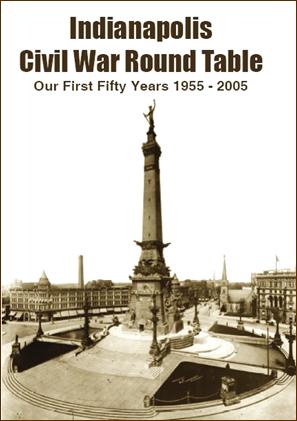
reported that editorial work on our forthcoming commemorative history, Indianapolis Civil War Round Table: The
First Fifty Years, is nearing completion.
The 112-page book should be available in time for our Golden Anniversary
celebration at the April meeting. Anyone
wishing to reserve a copy should return an order form, together with their full
payment, to Treasurer Doug Wagner no later than March 16th. The cost is $20 per volume for the hardback
edition and just $10 for the softcover version.
Nikki Schofield
announced that the ICWRT annual field trip is set for June 18-24, 2005. Billed as the “On To Richmond!” tour, the trip will include stops in Cincinnati,
Lexington and Richmond,
Virginia, and Lexington,
Kentucky.
The full itinerary and particulars may be found in the attached
information sheet. Space on the tour bus
is limited, so sign up now for a fun and educational experience. Nikki will be happy to answer any questions
you may have about the trip. She may be
reached at 317-328-8782.
Nikki will also
be conducting a “Civil War Generals Tour” at Crown
Hill Cemetery
on two Sundays this year, April 17th and October 2nd. Crown Hill is the nation’s third largest
cemetery and the last resting place of some 17 Civil War generals. Each tour will begin at 2:00 p.m. and will last approximately two hours. See the Calendar
of Events in this issue of HARDTACK
for more information.
50th Anniversary Desk Caddies Still
Available!
Don’t miss out on your
chance to buy a 50th Anniversary commemorative desk caddy. The black
leatherette caddies, which contain a notepad and compartments for pens and
other desktop miscellanea, feature the Soldiers and Sailors Monument and “Indianapolis Civil War Round Table / 50th Year
1955-2005” imprinted in gold on the cover.
Each of our speakers this year will be receiving one of these caddies as
a gift. The desk caddies are available
to members on a first-come, first-served basis, and will be available for
purchase at the March meeting. The cost
is $20 each.
Celebrate your membership in ICWRT on
its 50th Anniversary!
Reserve your copy
of Indianapolis Civil War Round
Table: The First Fifty Years, TODAY!!
An order form is
included with this issue of HARDTACK.
Remember---your order must be placed by March
16, 2005, for
delivery at the Anniversary
celebration meeting in April
|
|
Upcoming ICWRT Programs
All of the
following meeting dates are the second Monday of the month.
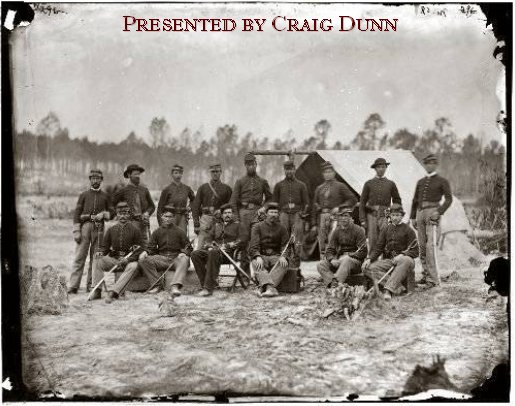
March 14, 2005 Indiana Regimental Photographs Craig Dunn
April 11, 2005 Draft Riots Iver Bernstein, Washington University
May 9, 2005 Topic to be Announced Mark Neely, Penn State University
June 13, 2005 Annual Banquet/ Battlefield Dave Duncan and Jim Lighthizer,
CWPT
Preservation Update & Fundraiser

Calendar of Events
|
March 14
|
ICWRT: Indiana Regimental
Photographs presented by Craig Dunn
Indiana Historical Society Auditorium, 450
West Ohio, Indianapolis, IN 7:30 PM
https://www.indianapoliscwrt.org
|
|
March 15
|
“Will
Stott’s Civil War”: first person presentation by Dr. Lloyd Hunter
Franklin College campus Chapel, Franklin, IN
For more
information, call Lloyd at 317-738-8221 (office)
|
|
March 16
|
Clay-Carmel
CWRT: Morgan's Raid presented
by Dick Skidmore
Monon Depot Museum, 211 First Street, S.W., Carmel, IN 7:30 PM
|
|
March 20
|
Randolph County CWRT: “Memories of the Blue and Gray, Part 3”
presented by Steve Jackson; Randolph County Historical Society Museum,
416 South Meridian St., Winchester, IN; 1:30 to 3:00 PM
|
|
March 21
|
Madison
Cty. CWRT: Civil War Genealogy presented by Amy Johnson
Anderson Public Library, Anderson, IN 7:30 PM
|
|
March 22
|
CWRT of West Central Indiana: Civil War Portraits of Alexander Lawrie
presented by Dick
Skidmore
F.W. Olin Biological Sciences Building, Depauw University campus
Greencastle, IN 7:30 PM
http://www.rose-hulman.edu/civilwar
|
|
April 17
|
Crown
Hill Cemetery Civil War Generals Tour conducted by Nikki Schofield
2:00 to 4:00 p.m. $5 for adults, $4 for
seniors and $3 for students
Enter Crown Hill by the 34th Street gate, off Boulevard Place. For more information, contact Nikki
Schofield (317-328-8782)
|
 We
recommend confirming all dates, times and locations for events not sponsored by
the ICWRT
We
recommend confirming all dates, times and locations for events not sponsored by
the ICWRT
If you know
of a Civil War-related event that may be of interest to ICWRT members, please
send your information to Norris Darrall (norrisdarrall@hotmail.com) and HARDTACK (HardtackEditor@comcast.net).
Trimble’s Trivia
1. What unit was known as, “Jeff Davis’s Pet Wolves”?
2. What was the object known as, “Jefferson Davis”?
3. Why did the U.S. Senate reject the nomination of
Col. Robert Buchanan
to the rank of
Brigadier General?
4. What was the Austrian Lorenz?
5. Where was Slaughter’s Field?
---Answers
will be published in the April issue---
Answers
to February’s Quiz:
1.
What is a “bog-trotter”? Slang for an
Irish soldier, used by both sides.
2.
What is a “hospital bullet”? A substitute for anesthetic, literally biting on a bullet
3. Presidential slang used by Union troops to
describe hardtack. “Lincoln Pie”
4.
What was “robbers’ row”? Area of camp reserved for sutlers
5.
Who or what was known as the “Provost Marshall”? A large shark
that patrolled the moat at Ft. Jefferson

Have you turned in your
Survey?
If you have not yet turned in a completed
Member Survey, please do so at the March meeting. Your responses may also be
mailed or emailed to Tony Roscetti using the form accompanying last month’s
edition of HARDTACK.
The
Survey is intended to help us better understand the interests of our
members. The information you provide
will not be disclosed to anyone outside our organization.
 From the Bookshelf
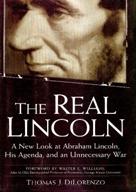
“The Real Lincoln: A New Look at Abraham Lincoln, His
Agenda, and an Unnecessary War” by Thomas J. DiLorenzo (Three
Rivers Press 2002) 333 pp.
The
“Real” Lincoln? Hardly.
A review by Dave Klinestiver
Looking beyond the myth, and seeking the historical
“truth” of the matter, is fundamental to the task of every historian. Finding new meanings and interpretations in
the events of the past, moreover, is rightfully the purview of each succeeding
generation of historical commentators.
There is no excuse, however, for any serious historian—and certainly not
a professional scholar of academia—to claim to offer readers the “real” story
of a man and his era when the writer has not bothered to master the essential
facts of his subject matter.
This reviewer first became aware of Thomas DiLorenzo
and “The Real Lincoln” about a year ago, when Book-tv (on C-SPAN2) aired a talk given by the
author at a booksigning. When DiLorenzo
began his presentation by stumbling over—and then misstating—the years in which
this country was “engaged in a great civil war,” it was evident to me that the
author’s scholarly authority fell well short of the demands of his subject. As I listened that evening to DiLorenzo rave
on about Lincoln’s “real agenda” (in sum: to promote Northern industrialism and a federal empire by waging
a bloody and “unnecessary” war to economically and politically subjugate the
South), it was clear to me that the person with the real agenda was Mr. DiLorenzo.
The book itself only confirms those initial
impressions. Rather than presenting his
readers with a balanced, scholarly analysis of Lincoln’s political/social/economic
principles and beliefs and how those views informed and influenced his
decisions as president, DiLorenzo seems more intent on recasting Lincoln’s mythic
image as the Great Emancipator to that of the Great Instigator of all Evils of
post-Civil War America and, by doing so, to further his own Jeffersonian
interpretation of American political-economic history.
DiLorenzo paints Lincoln as a conniving, power-hungry politician and economic
“mercantilist” (even worse, in the author’s opinion, than a capitalist!) who
was morally indifferent to slavery, and who merely used the issue to bolster
his own political ambitions and objectives.
By ignoring context and the full historical record, by using selected
facts to draw conclusions that are as outrageous as they are fallacious, and by
imbuing Lincoln with a prescience of future events and consequences surpassing
that of Nostradamus, DiLorenzo manages to construct a character that is utterly
unrecognizable to anyone familiar with the man, however complex and enigmatic,
that emerges from a wealth of primary source material—beginning with Lincoln’s
own writings—as well as innumerable studies over many decades that DiLorenzo chooses
to dismiss as whitewashed mythologizing.
As a professor of economics at the School of Business and Management at Maryland’s Loyola College (not to be confused with Loyola University in Chicago) specializing in political history and political
economy, DiLorenzo is certainly entitled—and presumably qualified—to champion
his own views on the subject of United States economic history.
In examining his book, however, it is clear that DiLorenzo has not
bothered to undertake anything close to a scholarly investigation into Lincoln’s evolving views on slavery, economic development or
the role of the federal government. DiLorenzo
also lacks an appreciation for the times and political/social culture in which Lincoln lived and which imposed (as Lincoln himself well
understood) significant constraints on what he could effectively
accomplish. Whatever period of history it
is in which DiLorenzo qualifies as a “specialist,” it is clearly not the Civil
War and antebellum eras of this country.
One need only look at the book’s bibliography to see
the shortcomings of DiLorenzo’s scholarship.
Beyond the paucity of references to leading works in the Lincoln canon
(which one would expect to find in any academic work, whatever its ideological
bent), DiLorenzo actually cites Gore Vidal’s Lincoln, a pseudo-biographical work of fiction no less, as one of
his background sources! (the book itself is not mentioned in DiLorenzo’s text). It is not surprising that no leading Civil
War or Lincoln historian has endorsed this book, particularly since
DiLorenzo manages to denigrate most of them by name. It is also telling that DiLorenzo’s two “anonymous
peer reviewers” apparently asked that they not be identified in his
acknowledgments.
Every year brings dozens of new books about Lincoln on top of the thousands of titles published over the
preceding 140 years. Some are very good
and a few are outstanding; others are mediocre—or worse. What is particularly unfortunate about this
book is that, as a work with the imprimatur of authorship by an academician,
less informed “mainstream” readers—not just the die-hard “states’ righters” who
are predisposed to this sort of thing—may actually buy-in to the misrepresentations
and contrarian claptrap espoused by DiLorenzo as historical truth.
If you want to read a libertarian rant on the evils wrought
by the Republican Party and the federal government during and after the Civil
War, you will undoubtedly enjoy DiLorenzo’s book. If, however, you are in search of a fair and
balanced view of the “real” Abraham Lincoln, you will not find him here.
|
Twp ICWRT
Member-Authors Are Critiqued in DiLorenzo’s “The Real Lincoln”
By Nikki Schofield
The views of two members of The
Indianapolis Civil War Round Table, Alan T. Nolan and Lloyd A. Hunter, are
critically assessed in Thomas DiLorenzo’s book, “The Real Lincoln,” which is subtitled “A New Look at Abraham Lincoln, His Agenda, and an Unnecessary War.”
In reference to “The Myth Of The Lost Cause And Civil War
History,” co-edited by Nolan and Gary W. Gallagher, DiLorenzo writes
that: “The book’s premise is that the doctrine of states’ rights had no real
history but was fabricated after the war by disgruntled former Confederates
to rationalize the secession of 1861” (p. 262). DiLorenzo specifically cites Nolan’s
assertion that slavery—not the right of secession—was the fundamental cause
of the War. DiLorenzo disagrees,
accusing the authors of “spreading untruths and distorting history” and even
“shoddy scholarship” (p. 263).
DiLorenzo also disputes Lloyd
Hunter’s assertion that Confederate mythmakers “fabricated another supposed
falsehood—“that the Constitution of 1787 had been a compact among equally
sovereign states.” DeLorenzo argues
that the Constitution was indeed a compact among thirteen sovereign states,
several of which reserved their right to withdraw (p. 262).
According to DiLorenzo, “Lincoln
and the Republicans certainly had a cause: the cause of centralized
government and the pursuit of empire” (p. 263). DiLorenzo describes Lincoln as a rhetorically gifted,
fence-straddling politician who wanted to favor and also to oppose racial
equality. He defended the natural
rights of all races, but opposed the right of blacks to vote, to serve as
jurors, and other rights then limited to white male citizens. (p. 13). DiLorenzo also characterizes Lincoln as a defender of slaveowners (pp.
12, 15), a wartime dictator who “led the way in subverting constitutional
government in America” (p. 6) and, at least by
implication, an unindicted “war criminal” (p. 198).
Although DiLorenzo’s text does
contain end notes that list sources, many of his statements are not cited to
any specific authority. As a result,
the reader is left to wonder as to the basis for many of the author’s bold
and highly controversial assertions.
|
Revealing The Real Lincoln
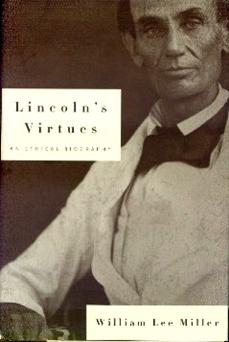 Anyone looking for the “real” Abraham Lincoln
would do well to read Lincoln’s Virtues: An Ethical Biography by William Lee Miller (Alfred A. Knopf 2002)
515 pp. Published the same year as DiLorenzo’s “The
Real Lincoln,” Miller’s study stands in stark contrast to DiLorenzo’s
“slash and burn” exposition, distinguished in terms of both the depth and
breadth of the author’s preparatory research as well as the intelligent insights
and conclusions he draws from the material.
Anyone looking for the “real” Abraham Lincoln
would do well to read Lincoln’s Virtues: An Ethical Biography by William Lee Miller (Alfred A. Knopf 2002)
515 pp. Published the same year as DiLorenzo’s “The
Real Lincoln,” Miller’s study stands in stark contrast to DiLorenzo’s
“slash and burn” exposition, distinguished in terms of both the depth and
breadth of the author’s preparatory research as well as the intelligent insights
and conclusions he draws from the material.
Like DiLorenzo, Miller is an academic but not a professional
historian. Trained as a social ethicist who has taught at Yale University, Indiana University and the University of Virginia, Professor Miller is nevertheless well-versed in American antebellum
history and politics. His earlier study
of the turbulent congressional debates over the peculiar institution, Arguing About Slavery (1996), was widely
praised by historians as well as critics for its well-researched and highly
readable approach to its subject. In Lincoln’s Virtues, Miller offers an
original and fresh perspective on the familiar facts of Lincoln’s life which (in contrast to DiLorenzo) the
author has clearly mastered along with the rich historiography of Lincoln biography.
Following a generally chronological path, Miller examines Lincoln’s experiences, motivations and evolving beliefs
and values over the course of his life, particularly during the
pre-presidential years. Relying
extensively on Lincoln’s own words, both public and private, Miller—as
effectively as any other Lincoln scholar—is able to “get inside the head” of his
subject to analyze and persuasively explain the rationale behind many of Lincoln’s decisions and actions.
Despite a title that may suggest otherwise, this book is not an
uncritical, laudatory tome to the Lincoln Myth. To
the contrary, Miller strives to look behind the Lincoln of popular legend to the flesh-and-blood man—and
ambitious politician—in the context of his times. Miller does not paper-over Lincoln’s contradictions and shortcomings; he does,
however, convincingly reveal how Lincoln’s awesome intelligence, commitment to principle
and inherent desire to do what is right in the confines of a deeply prejudiced
society—all contributed to the genuine greatness of the man who became the
mythic icon.
Indiana Historical Society
Opens The Faces of Lincoln Exhibition
On February 12th, the
Indiana Historical Society opened its new permanent exhibition entitled The Faces of Lincoln. Drawing on documents and images from three
significant collections acquired in 2003, the IHS plans to have revolving
displays of original materials tied to various themes relating to Lincoln and his era.
Initially, the exhibition will focus on Lincoln and Politics, featuring political cartoons, lithographs,
patriotic envelopes and other period ephemera, as well as images of Lincoln and members of his cabinet. Future themes include Lincoln in Photographs and Lincoln
and Family.
The IHS has completed the scanning
of some 840 images from its Lincoln collection. Digital images can be viewed through the Historical
Society’s website at www.indianahistory.org.
Andy Jacobs Speaks On Lincoln at Presidents’ Day
Program
On the evening of February 21st—Presidents’
Day—a large audience gathered at the Glendale Mall branch library for a program
entitled, "Honoring Lincoln: Why We Remember Our 16th President.” Former Congressman
Andy Jacobs, Jr. was the featured speaker for the event, which was co-sponsored
by The Lincoln Group of Indiana and the Indianapolis-Marion County Public
Library.
Congressman Jacobs is one of 15 members
of the Abraham Lincoln Bicentennial Commission, a body created by Congress to promote
the celebration of the 200th anniversary of Lincoln’s birth in 2009. In addition to enjoying Mr. Jacob’s appreciation
of the 16th president, the audience had an opportunity to speak with
19th century residents of Freetown Village as well as Civil War era “living
historians”—including our own Nikki Schofield (in the guise of condemned Booth
co-conspirator, Mary Surratt) and Norris Darrall (wearing the uniform of an Indiana soldier of the Veteran Reserve Corps
serving at Camp Morton).
 A number of other ICWRT members were
also in attendance, including Alan Nolan, whose scholarship and contributions
to Civil War history were recognized by Mr. Jacobs in his remarks.
A number of other ICWRT members were
also in attendance, including Alan Nolan, whose scholarship and contributions
to Civil War history were recognized by Mr. Jacobs in his remarks.
Angie Gilmer, President of the
Abraham Lincoln Group of Indiana, introduced the program. The Group (formerly known as the Abraham
Lincoln Association) is a non-political “round table” of individuals dedicated
to learning about the life and contributions of Lincoln.
The Abraham Lincoln Group meets six
times a year at the Nora branch library.
Their next meeting will be Thursday, April 14,
2005—the
140th anniversary of Lincoln’s assassination. For more information about the organization
and membership, contact Angie Gilmer at 253-8857 or aeg123@sbcglobal.net.
HARDTACK, the newsletter of The Indianapolis
Civil War Round Table, is published monthly, September through June,
each year. In addition to information about upcoming
programs, HARDTACK features articles, news, reviews and
a calendar of Civil War-related events. HARDTACK is
distributed by mail or email to all ICWRT members.
If you have a short article, book review or some
other item that may be of interest to our members, we invite you
to submit it for consideration. Please send your
material via email to the editor at: HardtackEditor@comcast.net.
Please include a telephone number and email address where we may contact
you.
Visit the
website of The Indianapolis Civil War Round Table: https://www.indianapoliscwrt.org/
“On To Richmond!”
The Annual Trip of The Indianapolis Civil War Round Table
June 18-24, 2005
Conducted by Nikki Schofield
Home phone: 317-328-8782
Email: Nikki1942@sbcglobal.net
The Capital of the Confederacy is our destination this year!
Ø
Saturday, June 18, meet the bus at 7:30 a.m. in the parking lot of the Ramada
Limited East, 7050 East 21st Street, phone 317-352-0481. The bus, owned by Star of America (formerly
Star of Indiana), will have our favorite driver, Noah Young, at the wheel. You will need to sign a release for the
motel, saying that you do not hold them responsible for your car. In previous years, you had to bring a copy of
the signed release with you, but this year, you can just sign it when you
arrive. Try to car pool, as space is
limited. We will depart from Indianapolis at 8:00 a.m.
If you have not been on a trip with us before, and therefore need a map
showing our departure location, please ask me.
Our first
stop on Saturday, about 10:00 a.m., will be the Freedom Center (Underground Railroad Museum)
overlooking the Ohio River. We will eat lunch here, before
heading south. Saturday night, we will
stay in the Comfort Inn, Charleston, W.Va. phone 800-798-7886.
Ø
Sunday, June
19, we will drive to Lexington, Virginia, where we will tour the historic
town, cemetery, and Stonewall Jackson House.
In Richmond, we are staying four nights in the
Hampton Inn, 800 Research Road, phone 804-897-6099. At 7:30, our evening speaker is Sam
Craghead of the Richmond CWRT, speaking on Drewry’s Bluff.
Ø
Monday morning,
June 20, we will tour Hollywood Cemetery with guides. We will lunch at the Museum of the
Confederacy, where we will have two guides.
The White House of the Confederacy tour and a seminar will be
included. In the evening, Bob Krick,
National Park Historian for Richmond Battlefield Park, will be our speaker at 7:00 p.m.
Ø Tuesday, Petersburg will be our destination. We will visit Pamplin Park, where we will see the
Breakthrough, and have lunch in the museum cafe. In the afternoon, we will visit The Crater
at the Petersburg National Battlefield Park, and see Drewry’s Bluff on
our way back to the motel. Our dinner of
Southern Comfort Chicken, a specialty of the house, will be at the historic Jefferson Hotel, on
their mezzanine at 7:00.
Ø Wednesday, we will tour Tredegar Iron
Works on the James River in the morning, and the Medical Museum at the site of Chimborazo Hospital in the afternoon. The evening speakers will be Charlie Cook and
Mark Gorman.
Ø
Thursday
will be a day of driving. As you know,
time on the bus is never wasted. We will
have videos to watch, Civil War music to listen to, and Civil War enthusiasts
with whom too talk. We also have an open
microphone, so you can share your favorite trip, CW personality, book review,
or thoughts on the trip, with your fellow travelers. We will stay in the Comfort Inn, Barboursville, West Virginia that evening. Their phone number is 304-733-2122.
Ø
Friday, June
24, we will drive to Lexington, Kentucky and visit the John Hunt Morgan
House and Civil War Museum, before arriving back in Indianapolis in the late afternoon. I estimate arriving about 5:00 p.m., but there are no guarantees for
ETA.
What
you do not need -- You
do not need to be a member of a Civil War Round Table in order to go on this
trip. Nor do you need any prior
knowledge of places or events in Richmond.
Our guides and speakers will fill you to overflowing with knowledge
about that important city during the Civil War. You do not need to submit a form, just your
check with name, address and phone number.
You do not need a parking release, because those will be available when
you arrive at the Ramada Limited East.
COSTS:
Star
of America bus $130.00
Comfort
Inn, Charleston, W.Va. 46.00
Hampton
Inn, Richmond, Va.
209.00
Comfort
Inn, Barboursville, W.Va. 40.00
Freedom
Center 10.00
Box
lunch in Lexington, Va.
10.00
Stonewall
Jackson House 5.00
Hollywood Cemetery 7.00
Pamplin
Park 12.00
Tredegar
Iron Works free
Petersburg National Park 3.00
Museum
of the Confederacy
(including box lunch)
28.00
Jefferson
Hotel chicken dinner 40.00
John
Hunt Morgan House 5.00
Mail, phone, postage 5.00
Total: $550.00
This
price is based on two people per room. If you want a private room, the cost
will be higher. If you need a roommate,
I will try to pair you up with someone, upon mutual agreement.
Down
payment -- Please
make a down payment of $100.00 as soon as you know that you can go, and
the remaining $450.00 by May 18, 2005.
Cut-Off
Date – May 18 is
the cut-off date, because I have to give final numbers to motels and the places
we will visit, one month before we leave.
We
would be happy to welcome first-timers on our trip.
My new
email address is: Nikki1942@sbcglobal.net.
Now, it’s ON TO RICHMOND!